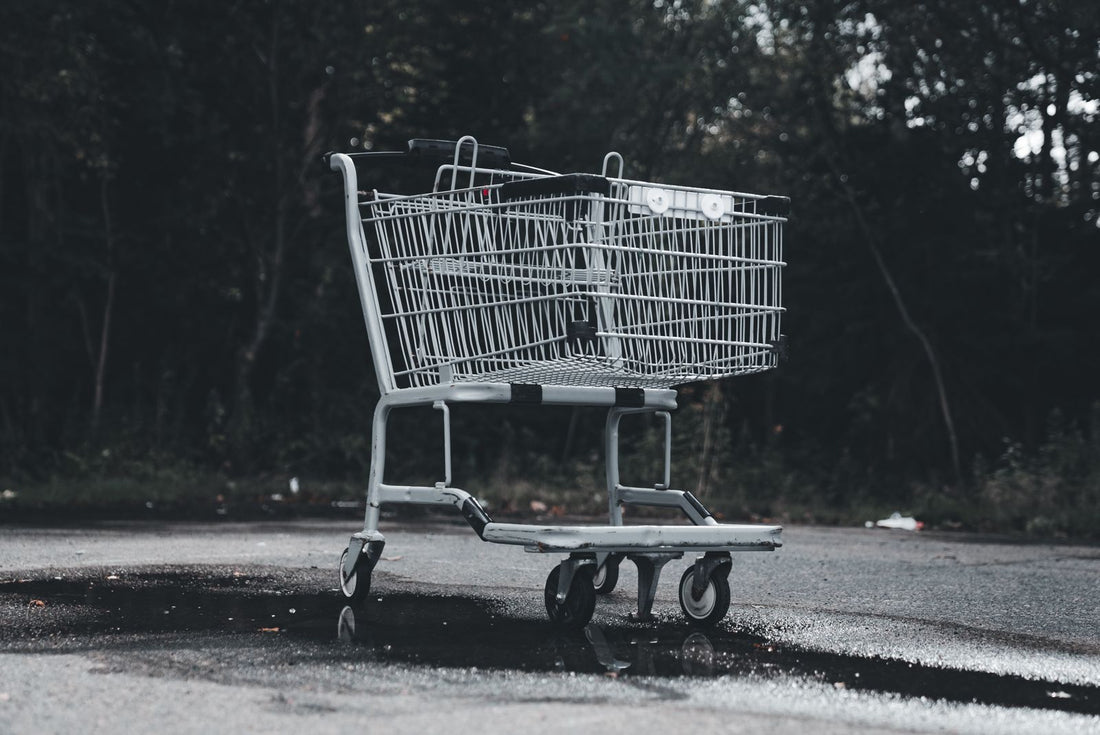
Roughly seven out of ten carts on a Shopify store never reach a confirmation page. That number has barely moved in a decade, and neither has the standard response: three emails, and by the second there is a coupon in it. Ten percent off. Then fifteen. Then a final chance twenty.
It recovers carts. It also teaches your best customers that the fastest route to a lower price is to load a cart and walk away from it. Once a shopper learns that, abandonment stops being friction and becomes a strategy. You are not recovering revenue at that point. You are running a discount program with extra steps.
Here is how to win carts back at full price.
What a recovery discount actually costs
Take a $100 cart on a store running 55 percent gross margin. That order carries $55 of gross profit. A 15 percent recovery code takes $15 off the top, which is 27 percent of your gross profit on that order. Push to 20 percent off and you are handing over $20, or 36 percent of the profit. The revenue line still looks fine. The profit line is where the money left.
Now the part that rarely gets modeled. That code does not only reach the shoppers who needed it. It reaches everyone on the flow, including the large share who were coming back anyway: price checkers, people waiting on payday, people who were shopping on a phone in line somewhere and meant to finish at home. Every one of them just got a discount they did not require.
Then there is the durable damage. A shopper who gets 20 percent off for abandoning once will abandon again. You have set a new reference price. We covered how that anchor erodes in discount fatigue, and the cart flow trains it fastest, because the feedback loop is hours long instead of weeks.
Sort the abandoners before you spend on them
Not every abandoned cart is the same problem, and only one of the four is actually about price.
- Cost surprise at checkout. Shipping, duties, or tax appeared and the total changed. This is a transparency problem, not a discount problem.
- Comparison shopping. They opened three tabs. Whoever answers the open question first wins, and the question is usually fit, sizing, or delivery date, not price.
- Interruption. Nothing was wrong. Life happened. These shoppers need a reminder, not money.
- Genuine hesitation on value. The real price objection. This is the only bucket where a financial incentive is doing legitimate work, and it is the smallest of the four.
Blanket coupon flows pay all four buckets at the same rate. That is the whole inefficiency.
Five ways to recover the cart at full price
1. Fix the cost surprise instead of discounting around it
If shipping breaks the cart, a 15 percent code is an expensive way to pay a $9 shipping charge. Show delivery cost and delivery date on the product page and in the cart, before checkout. Move that disclosure earlier and abandonment usually drops without a dollar of promotional spend, because the shock is gone.
2. Make the incentive conditional on something that has not happened yet
This is the mechanic we build at Playably. Instead of "come back for 20 percent off," the offer is "come back, pay full price, and get 100 percent of it back if a specific real world event happens." A team wins. It snows on a given date. A player hits a milestone. The shopper checks out at your full price today, and the payout only occurs if the trigger resolves.
The economics are the reason this works. A 20 percent code costs you 20 percent on every single order it touches. A conditional rebate costs you the payout multiplied by the probability of the trigger. If the trigger has a one in ten chance of hitting, a 100 percent cashback offer carries an expected cost near 10 percent of the order, while the shopper is looking at an offer worth 100 percent. You are buying a larger perceived incentive for a smaller expected spend, and every order still books at full price. We broke the arithmetic down side by side in cash back versus discount codes.
Timing helps too. A coupon dies in 48 hours. A conditional offer keeps the customer engaged until the event resolves, often weeks later.
3. Recover with information rather than money
For comparison shoppers, the winning email answers the question they actually stalled on. Sizing guidance. A real customer photo. The return window. Stock level on the exact variant sitting in their cart. None of this costs margin, and it converts the bucket that a discount was never addressing in the first place.
4. Put the mechanic at the cart, not in the inbox
Recovery does not have to wait for an email. An interactive moment at the cart, a quick game or a reveal tied to the order already built, gives a reason to finish now. The Sak saw 5x the conversion rate on a quiz versus a standard capture unit, because participation is a lighter ask than a purchase decision. Ours live at Playably games.
5. Separate cart abandonment from dormancy
An abandoned cart is a live intent signal, hours old. A customer who has not bought in nine months is a different problem, and running the same coupon at both is how discount programs sprawl. The dormant side has its own playbook in winning back lapsed customers without discounts. Jones New York drove 5x revenue per send on a dormant list with a conditional offer instead of a price cut.
What full price recovery looks like in results
Buckle Me Baby Coats ran a conditional rebate and saw a 23 percent lift in sales on launch, at full price, with no sitewide discount underneath it. BlackBoxMyCar saw a 27 percent click through lift with $0 discount given up in its campaign window. Those are not coupon numbers. They are what happens when the incentive is big enough to move behavior and cheap enough not to eat the order. More in our case studies.
A four week rollout
Week one. Instrument the exit. Find where carts die, and how much of your current recovery revenue already carries a code.
Week two. Strip the discount out of emails one and two, replacing it with the cost transparency fix and the information answer. Hold the coupon to a single last touch so you can measure what it really contributes.
Week three. Pick a trigger your audience actually cares about (a game, a weather event, a season opener) and set the rebate and window around it. The model is at gamified rebates.
Week four. Run the conditional offer against your discount control on recovered revenue and on gross profit per recovered order. Judge it on the second number.
Frequently asked questions
Will removing the discount from my abandoned cart emails reduce recovered revenue?
Recovered order count can dip on the first touch while gross profit per recovered order rises. Run the test on profit, not recovery rate. A recovery rate is trivially easy to inflate: offer more money. What matters is what each recovered order is worth after the incentive is paid.
How does the shopper claim a conditional rebate?
Every campaign has an enrollment code. The shopper enters it at checkout to enroll the order, pays full price, and if the trigger resolves they are paid back automatically. No receipts to mail, no forms to chase. The code is also how attribution works, so you can see exactly which revenue the campaign produced.
Who carries the cost if the event actually happens?
Playably does. The payout is underwritten on our side, so the merchant knows the campaign cost before it launches, regardless of how the trigger resolves. You keep the full price order either way.
Stop paying for carts that were coming back anyway
The coupon in your recovery flow does three jobs at once: it rescues the small group with a real price objection, pays full freight for a much larger group who needed nothing, and trains everyone to abandon again next time. Split those jobs apart and only one needs money.
Want to see what a conditional rebate would cost against your current recovery flow? Book a demo and we will run the math on your numbers.
Parts of this post were drafted with AI assistance. Every post is reviewed and edited by a person at Playably before it goes live, and we take editorial responsibility for what it says.